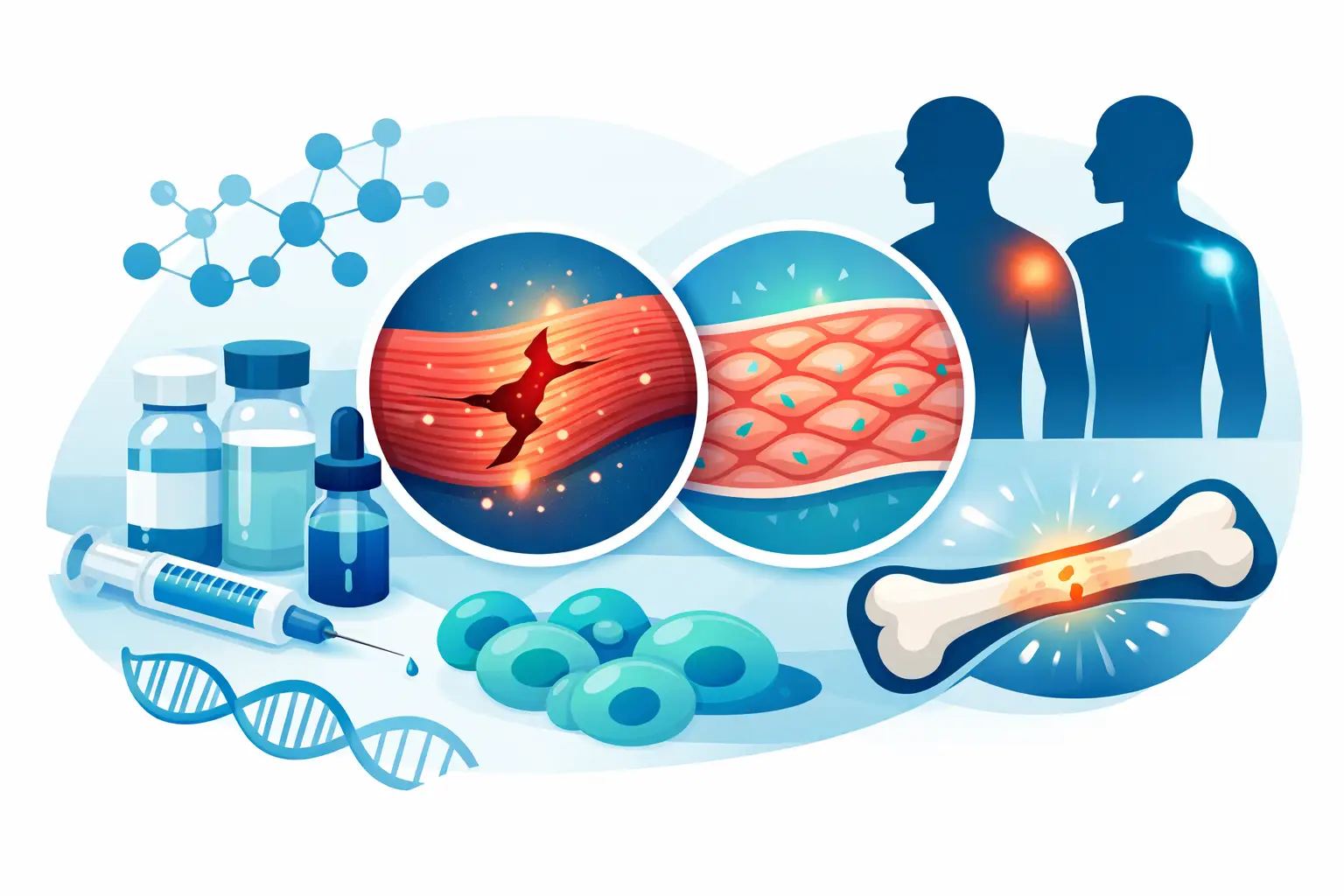

A strained tendon, stubborn joint irritation, and a slow-healing soft-tissue injury can all create the same question: which compounds are actually worth researching? The best peptides for tissue repair are not interchangeable. Each has a different proposed mechanism, evidence level, safety profile, and practical role in a research setting. A peptide that appears promising for tendon remodeling may not be the right subject for skin support, post-training recovery, or broader connective-tissue research.
For serious peptide buyers, the goal is not to chase the loudest claim. It is to assess the compound, the available data, the quality of the material, and the limits of what the evidence can support.
How to Evaluate Peptides for Tissue Repair
Tissue repair is a broad category. It includes inflammation control, blood-vessel formation, collagen production, cell migration, extracellular matrix remodeling, and the restoration of normal mechanical function. A compound may affect one of these processes without proving that it reliably heals an injury in humans.
That distinction matters. Many peptides discussed in recovery communities have encouraging preclinical findings, but limited or absent large-scale human trials. They should not be treated as FDA-approved therapies for injuries, chronic pain, surgical recovery, or medical conditions. Anyone managing a significant tear, fracture, infection, wound, or persistent mobility issue needs appropriate clinical evaluation first.
When comparing compounds, focus on the type of research available, the target tissue, formulation integrity, and whether a clinician considers the approach appropriate for your health history. Research-grade labeling does not turn an investigational compound into a proven medical treatment.
Best Peptides for Tissue Repair Research
BPC-157
BPC-157 is the compound most often associated with tendon, ligament, muscle, and gastrointestinal tissue research. It is a synthetic peptide derived from a sequence found in gastric juice protein. Interest in BPC-157 centers on its proposed influence on angiogenesis, nitric oxide signaling, inflammatory pathways, and fibroblast activity – all processes relevant to tissue repair.
Preclinical animal research has reported potentially favorable effects in models involving tendon, ligament, muscle, bone, nerve, and intestinal injury. That breadth is why BPC-157 remains a high-demand research compound among recovery-focused buyers. It is also why claims around it can become inflated quickly.
The limitation is clear: high-quality human clinical evidence remains limited, and BPC-157 is not FDA-approved for therapeutic use in the United States. It should not replace imaging, rehabilitation, surgery when indicated, or a clinician-directed recovery plan. For research audiences, its appeal is the depth of mechanistic and animal data, not a confirmed human outcome guarantee.
TB-500 and Thymosin Beta-4 Research
TB-500 is commonly discussed as a synthetic fragment associated with thymosin beta-4, a naturally occurring protein involved in cell movement, actin regulation, inflammation, and tissue repair biology. In preclinical settings, thymosin beta-4 has been studied across skin, cardiac, corneal, and musculoskeletal repair models.
Its proposed value lies in supporting cell migration and organized repair signaling rather than simply suppressing discomfort. That makes it a frequent topic in connective-tissue and post-training recovery research. However, TB-500 is often casually described as if it were a confirmed healing treatment. It is not. Product naming, purity, peptide sequence, and the relationship between TB-500 products and full thymosin beta-4 research can vary, so material verification is essential.
As with BPC-157, meaningful human data are limited, and TB-500 is not FDA-approved for treating tissue injuries. It also raises additional concerns for competitive athletes because peptides and related substances can be prohibited under sports anti-doping rules. Athletes should review their governing body’s current regulations before considering any investigational compound.
GHK-Cu
GHK-Cu is a copper-binding tripeptide with a different research profile from BPC-157 and TB-500. It is especially relevant to skin quality, collagen remodeling, wound-healing biology, hair research, and extracellular matrix support. GHK-Cu has been studied for its potential influence on collagen and elastin production, antioxidant activity, inflammatory signaling, and gene expression related to tissue renewal.
This peptide is better known in topical skincare and cosmetic research than in injectable recovery discussions. That distinction is useful. Someone researching dermal appearance, skin barrier support, or cosmetic tissue remodeling may find GHK-Cu more relevant than a peptide primarily associated with musculoskeletal models.
Its evidence base is still not a blank check for broad claims. Results can depend heavily on formulation, concentration, route of exposure, and the specific research endpoint. GHK-Cu may be a more targeted option for skin-focused research, while BPC-157 or thymosin beta-4-related compounds are more commonly evaluated in broader soft-tissue contexts.
CJC-1295 and Ipamorelin
CJC-1295 and ipamorelin are growth hormone secretagogues, meaning they are researched for their ability to influence growth hormone release and related pathways. They are not direct tissue-repair peptides in the same sense as BPC-157 or GHK-Cu. Their role is more indirect, tied to growth hormone and IGF-1 signaling, sleep quality, body composition, and recovery physiology.
That indirect role can still make them relevant in a broader performance and recovery research framework. Adequate growth hormone signaling contributes to normal protein turnover, connective-tissue metabolism, and body composition. But that does not mean these compounds should be viewed as a shortcut for healing an injury.
CJC-1295 and ipamorelin require extra caution for people with endocrine conditions, metabolic concerns, cancer history, or medications that affect blood sugar and hormone signaling. Potential effects on glucose regulation, fluid retention, appetite, headaches, fatigue, and hormone balance need to be considered with qualified medical guidance. Neither compound is FDA-approved as a general tissue-repair treatment.
Why a Peptide Stack Is Not Automatically Better
Combining multiple peptides is common in online recovery discussions, but more compounds do not necessarily mean better research outcomes. Stacking makes it harder to identify what caused a benefit, a side effect, or an unexpected change. It can also compound quality-control concerns and create unnecessary exposure when the underlying injury requires rest, rehabilitation, nutrition, or medical treatment.
A disciplined approach starts with a defined research question. Is the focus skin remodeling, tendon biology, generalized recovery signaling, or growth hormone pathway research? From there, assess one compound category at a time rather than treating every recovery peptide as part of the same toolset.
Quality Control Is Part of the Decision
For peptide researchers, product quality is not a secondary detail. Incorrect identity, poor purity, degradation, contamination, and inconsistent handling can invalidate results and increase risk. A credible supplier should prioritize transparent quality-control practices, appropriate storage standards, batch-specific testing where available, secure fulfillment, and clear product labeling.
This is particularly important with high-demand compounds such as BPC-157, CJC-1295, ipamorelin, and TB-500. A low price without meaningful quality assurance is not a value proposition when the material itself may be the variable that matters most. At Novaris Pharma, the emphasis on premium-grade research compounds and controlled distribution reflects the standard serious buyers should expect across the category.
When Tissue Repair Needs Medical Care First
Peptide research should never delay care for severe swelling, deformity, numbness, weakness, fever, an open wound, suspected infection, inability to bear weight, or pain that worsens rather than improves. Those symptoms can indicate problems that require diagnosis and treatment beyond any wellness or recovery protocol.
Even for less urgent issues, tissue repair has fundamentals that no peptide can replace: sufficient protein and calories, progressive rehabilitation, sleep, sensible training load, and treatment of the original cause. A tendon repeatedly overloaded by poor mechanics will not become durable simply because a recovery compound is added.
The right peptide question is not, “What is strongest?” It is, “What mechanism is relevant, what does the evidence actually show, and what risks am I willing to evaluate with professional guidance?” That mindset leads to better research decisions and keeps recovery focused on measurable, long-term function.





One thought on “Best Peptides for Tissue Repair Compared”