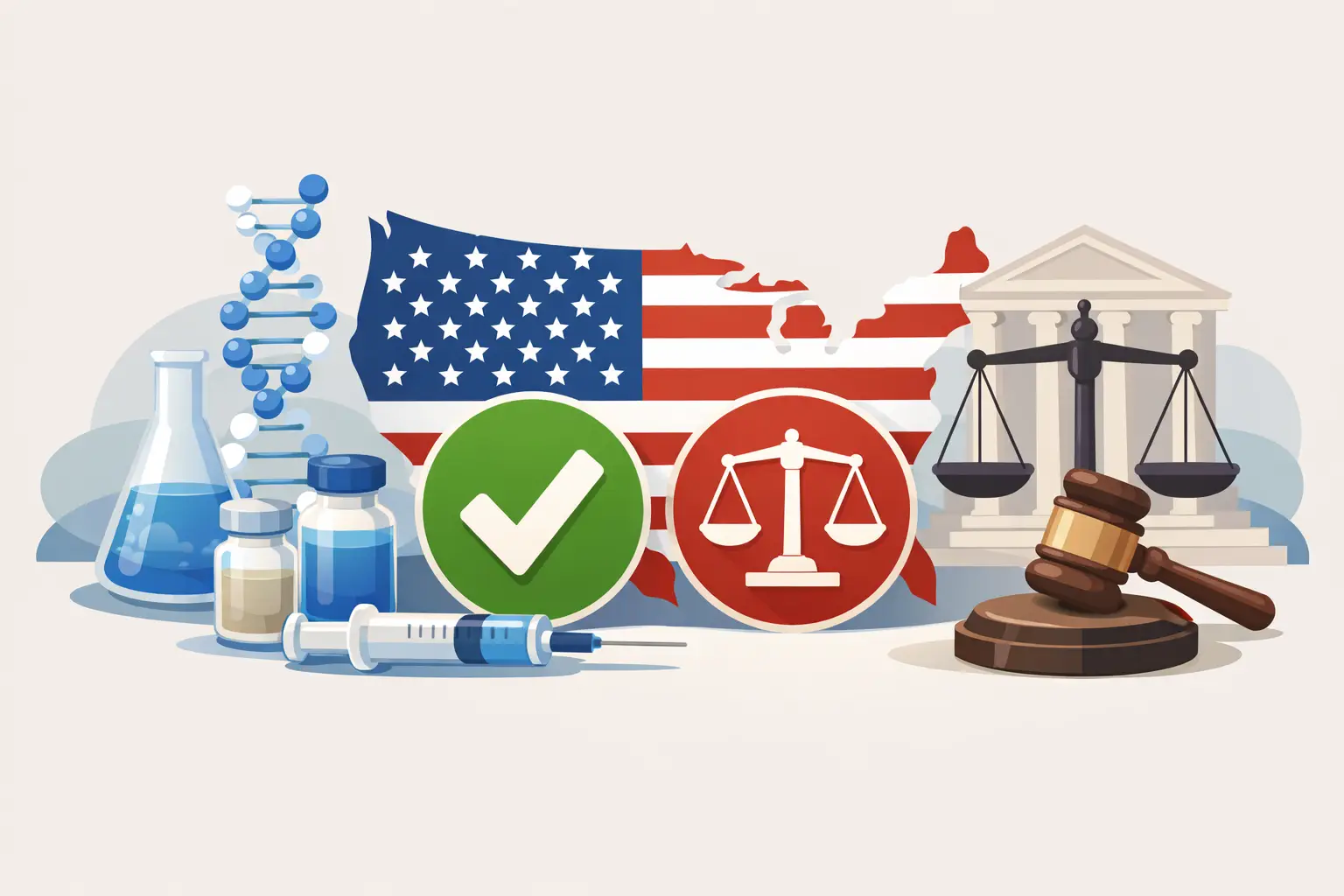

If you are asking are research peptides legal, you are really asking a more precise question: legal for what, legal where, and legal under which labeling and intended-use standard? That distinction matters. In the peptide market, the same compound can sit in very different legal territory depending on whether it is sold for laboratory research, compounded by a pharmacy, prescribed by a licensed clinician, or marketed for human use without approval.
For a serious buyer, the shortcut answer is this: research peptides are not simply legal or illegal across the board in the United States. Their status depends on the compound, how it is marketed, how it is labeled, who is buying it, and what use is being claimed. If you care about compliance, quality, and risk, broad assumptions are where people get into trouble.
Are research peptides legal under federal law?
At the federal level, there is no single rule that covers every peptide in one sweep. That is why the market can feel confusing even to experienced buyers. Some peptides are approved drug ingredients in specific contexts. Some exist in a gray area when sold strictly for research purposes. Some may trigger much tighter scrutiny because of how they are promoted, especially if a seller implies treatment, weight loss, recovery, anti-aging, or performance outcomes tied to human use.
The key issue is intended use. If a product is presented as a research chemical and not for human consumption, that is very different from a product being advertised as if it were an approved medication. Federal agencies look closely at claims, labeling, packaging, and sales language. A peptide marketed with dosing instructions for people or direct disease-treatment claims can move into a much riskier category fast.
That is why experienced peptide buyers pay attention not just to the name of the compound, but to the full compliance picture around it. Compound identity matters. So do product claims, testing standards, and how the item is distributed.
Why intended use changes the legal answer
This is the part many people miss. A peptide itself is not the whole legal story. The seller’s presentation can be just as important as the molecule.
If a product is sold as a research peptide, labeled accordingly, and not represented as a finished drug for human use, that tends to be treated differently than a product sold with consumer-facing claims about fat loss, healing, muscle gain, or cognitive benefits. The more a listing starts to resemble an unapproved drug advertisement, the more legal exposure increases.
This is especially relevant with well-known compounds such as BPC-157, CJC-1295, ipamorelin, selank, semax, and tesamorelin-related offerings. Buyers often come to these products because they already know the outcomes associated with them. But market familiarity is not the same thing as blanket legal approval for every use case.
The same principle applies to high-demand metabolic compounds. Semaglutide and tirzepatide attract strong consumer interest, but their legal treatment depends heavily on sourcing channel, regulatory status, and how they are being sold. Buyers should never assume that broad popularity equals unrestricted retail legality.
Are research peptides legal to buy online?
Sometimes yes, but not without conditions and not from every seller.
Online availability does not prove compliance. Many compounds can be listed on the internet, yet the legal and regulatory posture behind those listings can vary widely. Some sellers operate with clean research-use labeling, lot traceability, and serious quality controls. Others lean on aggressive marketing language that raises obvious red flags.
For buyers, that means the right question is not just whether a peptide can be purchased online. It is whether the product is being offered in a way that aligns with applicable law and whether the supplier is behaving like a serious operator.
A professional peptide retailer should make quality control visible. That includes clear product identification, careful labeling, batch consistency, and testing standards that support confidence in what is actually in the vial. In a category where legal and quality risk can overlap, those trust signals matter.
State laws can change the picture
Even if a product appears to fit within a federally tolerated lane, state-level restrictions can complicate distribution, possession, or shipment. Some states take a harder line on particular substances, and policy can shift over time. This is one reason reputable suppliers monitor fulfillment rules closely and may limit shipment of certain compounds to specific jurisdictions.
For the buyer, that means legality is not just about what is true at the national level. It is also about where you live. A compound that is available in one state may face restrictions in another, or a seller may choose not to ship there because the compliance risk is higher.
That is not a flaw in the market. It is the reality of operating in a regulated category where enforcement priorities and legal interpretation can differ.
What makes a peptide sale look higher risk?
Some patterns tend to attract more scrutiny than others. One is direct human-use marketing for products that are not approved to be sold that way. Another is sloppy or misleading labeling. A third is poor transparency around quality testing, which can turn a legal question into a safety problem very quickly.
Buyers should also be cautious when a seller makes broad medical promises. If the product page reads like a guaranteed treatment plan, that is a warning sign. In a serious market, precision matters. Suppliers that understand the category usually avoid casual overstatement because they know the line between research-use positioning and drug-style promotion is not theoretical.
This is where a trust-centered supplier stands apart. A disciplined operation focuses on product integrity, technical accuracy, and controlled distribution rather than hype.
Approved drugs, compounding, and research products are not the same
One reason peptide legality gets misunderstood is that buyers often group three separate categories together.
First, there are FDA-approved drugs that contain specific peptide-based ingredients and are used under approved medical pathways. Second, there are compounded preparations, which involve a different regulatory framework and their own restrictions. Third, there are research peptides offered outside those channels and labeled for research use.
Those categories should not be treated as interchangeable. A person may recognize a compound name from mainstream weight management or hormone-related discussions and assume every listing with that name carries the same legal standing. That is a mistake. The distribution channel and product classification matter just as much as the active ingredient.
How to think clearly about peptide legality before buying
A serious buyer should approach the question the same way a serious supplier does: with precision.
Start with the compound. Some peptides have a more established regulatory history than others. Then look at the labeling. Is the product clearly positioned for research use, or is it drifting into claims that suggest unapproved human use? Next, consider jurisdiction. Federal posture matters, but state restrictions can still shape what is allowed. Finally, evaluate the seller. Are they focused on premium-grade materials, testing, and controlled fulfillment, or are they relying on vague promises and promotional noise?
This is one area where buying cheap can become expensive. Low-integrity sellers create both compliance risk and product risk. If quality control is weak, even a product sitting in a less restricted category can become a bad decision.
Are research peptides legal if they are labeled not for human consumption?
That label helps define intended use, but it is not a magic shield.
Regulators can look past a disclaimer if the surrounding marketing tells a different story. If the site uses dosage language, transformation claims, or obvious human-use guidance, a small label does not erase the bigger context. In other words, the disclaimer matters, but conduct matters more.
That is why experienced operators keep their standards tight across the full customer experience. The legal picture is shaped by the product page, the packaging, the claims, and the fulfillment process together.
What careful buyers should take away
The peptide market rewards buyers who think in specifics. Asking are research peptides legal is a smart starting point, but the right answer is rarely one word. It depends on the compound, the claims, the label, the jurisdiction, and the supplier’s compliance posture.
For buyers who want premium compounds without unnecessary guesswork, the best move is to work with vendors that treat quality control and category discipline as part of the product itself. That means clear standards, transparent handling, and a business model built around precision rather than shortcuts. Novaris Pharma operates in that lane because serious customers are not looking for noise – they are looking for confidence.
If you are evaluating peptides for research or adjacent wellness goals, slow down long enough to verify the legal context before you click buy. Better decisions usually start the same way: with cleaner information, stronger standards, and fewer assumptions.